
Beyond Data Literacy: Building a Data-Minded Organisation
Originally published 9 June - https://fernleafadvisory.com - Written By Maria McLoughlin
Data literacy has become a common objective across government and industry.
Organisations invest heavily in training people to read dashboards, interpret reports, and understand metrics. These are valuable skills, but they often focus on only one part of the data journey.
The challenge is that understanding a chart does not explain where the data originated, how it moved through systems, who is accountable for it, whether it can be trusted, or how it should influence decisions.
Perhaps the bigger question is not whether organisations need more data literacy, perhaps they need more data-mindedness.
Data Literacy Is Necessary But Not Sufficient
Most data literacy programs focus on:
Reading reports
Understanding metrics
Interpreting trends
Using analytical tools
These skills matter, however, they often begin at the point where data has already been transformed into information. The reality is that decisions are affected by everything that happens before a dashboard is ever created.
Data quality issues
Ownership confusion
Governance gaps
Poor definitions
Disconnected systems
Unclear accountability.
Without understanding these factors, literacy can create confidence without context.
Understanding the Data Journey
The Fernleaf Data Flow Model™ provides a simple way to visualise how information moves through an organisation. It illustrates how data is created through organisational activity, how it is organised, managed, and maintained within systems, and how it ultimately supports decisions, actions, and organisational outcomes.
Modern organisations depend on data to operate, manage risk, and deliver services. Yet data is often treated as something static; stored within systems rather than understood as something that continuously moves and evolves through organisational activity.
The Fernleaf Data Flow Model™ presents a different perspective. It views organisations as living systems where data flows continuously through people, processes, and technology, much like nutrients moving through a plant. As information moves through the organisation, it is shaped by governance, management, quality, analysis, and leadership decisions. Understanding that flow helps individuals see not only the data itself, but also the responsibilities and decisions that influence its value and trustworthiness.
The Fernleaf Data Flow Model™ - Understanding How Data Enables Organisational Growth
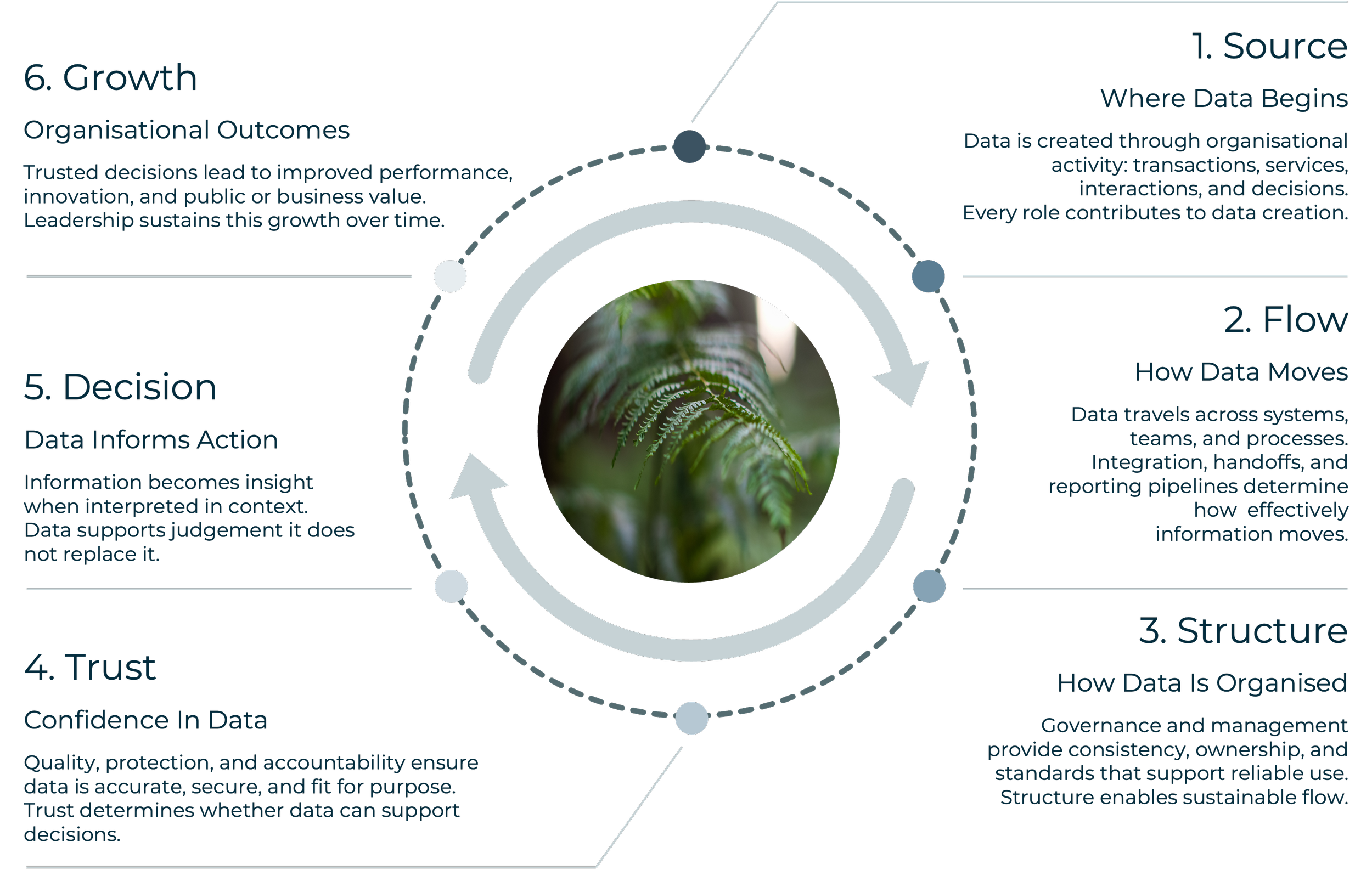
© 2026 Fernleaf Learning. All rights reserved
The Six Foundations of a Data-Minded Organisation
1. Understanding Data
Understanding what data is, where it originates, and how it differs from information.
2. Understanding Data Management
Understanding how data is collected, stored, maintained, integrated, and protected throughout its lifecycle.
3. Understanding Data Governance
Understanding how decisions about data are made, who is accountable, and how governance enables trusted outcomes.
4. Understanding Data Quality
Understanding how organisations create and maintain confidence in the data they use.
5. Understanding Analytics and Insight
Understanding how data is transformed into information, evidence, and organisational knowledge.
6. Understanding Leadership
Understanding how leaders create environments where evidence can be trusted, challenged, and applied to decision-making.
Why AI Makes This More Important
Many organisations are rushing towards AI literacy, yet AI magnifies existing organisational weaknesses.
If data quality is poor, AI scales poor outcomes.
If governance is weak, AI increases risk.
If ownership is unclear, AI creates new accountability challenges.
The organisations that benefit most from AI will not necessarily be those with the most sophisticated models but those with the strongest foundations.
Building a Common Language
One of the greatest benefits of data-mindedness is creating a shared organisational language.
People begin to understand:
Ownership
Stewardship
Quality
Governance
Trust
Evidence
Accountability
as connected concepts rather than isolated activities.
Data literacy remains important, but literacy alone is no longer enough.
Modern organisations need people who understand not only how to read data, but how data flows through an ecosystem, how trust is established, how decisions are governed, and how leadership influences outcomes.
The future belongs not simply to data-literate organisations, it belongs to data-minded organisations.
About Fernleaf Learning
Fernleaf Learning develops practical capability programs that help organisations build stronger data, governance, leadership, and decision-making practices. The concepts discussed in this article are explored further in the Digital Data Foundations program, which introduces participants to data flow, governance, management, quality, analytics, and leadership in modern organisations.